無 Heritage · 历史的回顾
A clan,
nine decades
in the making.
From a small group of elders quietly observing Qing Ming at Wuweigang in 1930, to a 50-committee institution today — this is the long arc of the Chang Clan in Singapore, told as faithfully as the records permit.
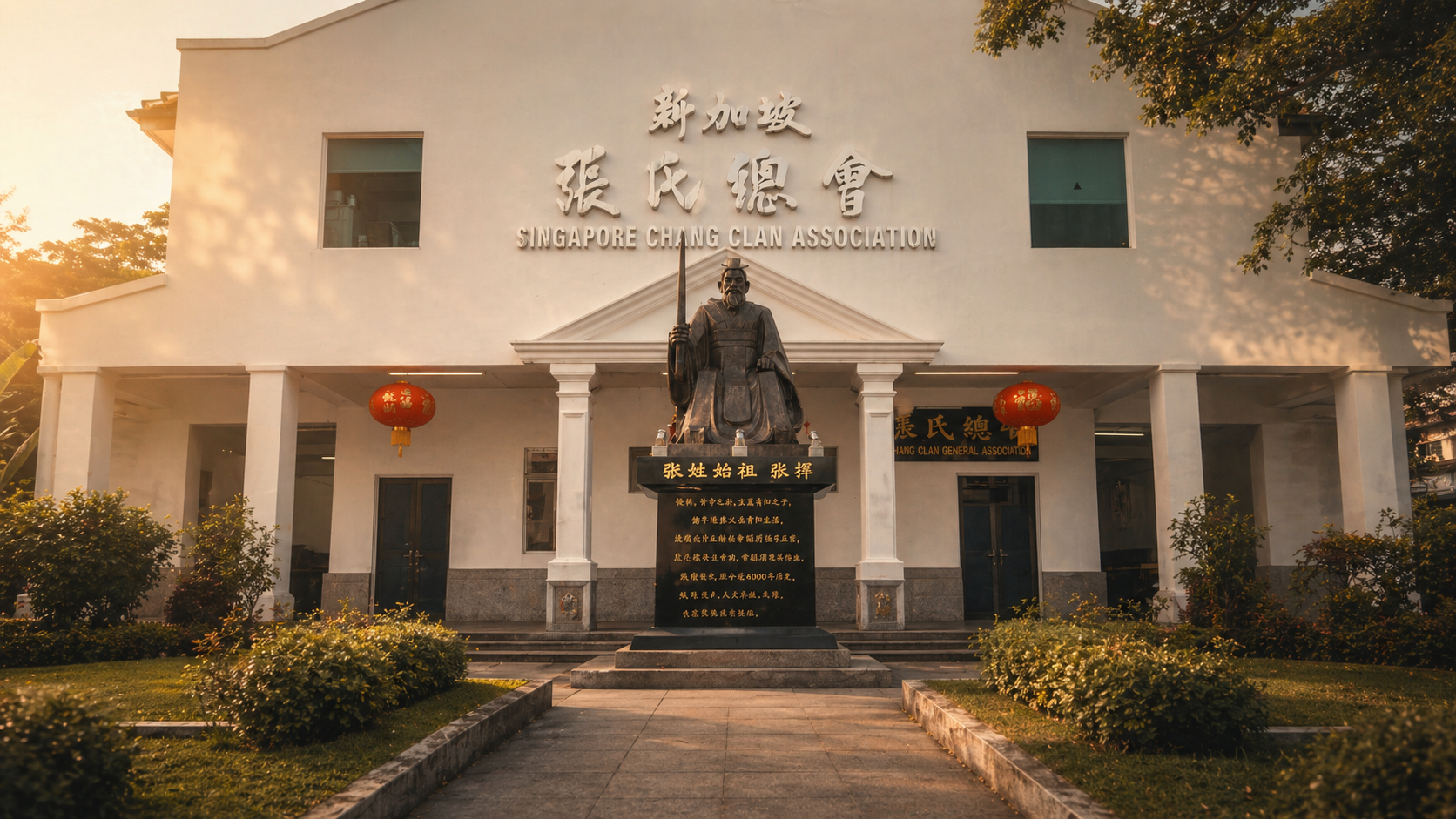
"If you do not know what happened before you were born, you remain a child forever. If human life is not joined to the lives of those who came before, what is its value?"
— Cicero, On the Orator
An old horse, a thousand miles still ahead.
The earliest record we have begins in 1930. Three elders — Jian Jin, San Pin, Yi Fan — gathered a handful of clansfolk at a place locally called Wuweigang to observe the ancestral rites. The gathering was small. It was meant only to remember.
Year by year more kin attended, until the elders agreed to organise a formal rite each Qing Ming, drawing on the strength of all Singapore's 張. Money was raised among clansfolk and from local merchants. Offerings were prepared. Names were carried in memory. Through these rites, ties between kin grew strong enough that, by 1937, the elders Qiong Lin and San Pin proposed something larger: a formal society.
That spring, at the Qing Ming banquet, the motion passed. Jin Zhi, Jian Jin, Tian Yu, Shu Yuan, Yi Fan, Ma Deng, De Fa, Qi Nan, Wen Liu, Zai Lai, Tian Fu, Wen Huang, Ji Fu — their names are listed in the founding minutes. Wen Huang lent five hundred dollars to begin. The first meeting was held in a borrowed reading room on Qixin Street, founded by Hainanese kin. Jin Zhi was elected the first President.
Bonded through hardship.
Borrowing premises soon proved unsustainable. A second-floor unit at 29 China Street was rented and the Association, briefly named the "United Malayan Zhang Clan Association", extended its reach across all 13 states of Malaya. Distance, however, made a regional remit impractical: when a Malayan member died, sending people from Singapore to attend funeral rites was difficult. The scope was reduced, and in time the body settled on its present name — the Chang Clan General Association.
In the same year, the Association was registered with the Straits Settlements government. The opening was officiated by the Republic of China's Consul to Singapore. The Association's first permanent home was purchased shortly after — the entire three-storey Cuilan Ting at 65 Kreta Ayer Road. The President pledged a thousand dollars; within a month, ten thousand had been raised.
From these premises the rites continued and a Mutual Aid Society was founded — separately registered with the government, with its own committee, dedicated to handling funeral arrangements and the welfare of members.
The war years.
By 1941, with Japan having occupied northeastern China and its forces marching south, life in Singapore grew anxious. President Jin Zhi joined an underground anti-Japanese resistance, raising funds for the war effort. He was arrested. He did not give up his comrades. He died in prison at fifty.
From 1942, all clan associations were banned from operating. The records of the 6th and 7th committees are blank. What kept the Association alive in those years was the quiet refusal of a handful of elders — San Pin, Jian Jin, Tian Yu, Shu Yuan, Qi Nan — to abandon the empty premises. They preserved them through humiliation and hardship. We owe them everything.
By late 1944, with Japanese garrisons reduced by Allied counterattacks, San Pin secretly convened the elders to plan the Association's revival. He was elected the new President of the 8th committee. Open work could not yet begin. When victory came in 1945, the elders gathered again and put a notice in the newspapers: re-register, the clan is still here.
Renewal and steady growth.
Re-registration alone was insufficient. The elders divided Singapore into twelve districts, each with its own registrar. Within three months, more than 700 members had signed up. At year-end, the General Members' Meeting saw the largest attendance in the Association's short history. Property trustees were elected for the first time. Terms were extended to two years.
Shu Yuan, by then the unanimous choice, took the 10th presidency. He served seven consecutive terms — from 1946 to 1959. This was the first long stretch of stable growth, and most of the institutional shape we recognise today comes from those years. He was followed in 1960 by Han San, who served three terms and led the Association firmly outwards into wider Singapore society, beginning a tradition of welfare work that continues now.
Prestige, and the building itself.
In 1966, the Hakka business leader Zhang Mengsheng — eldest son of the founder Yunqing — took the 20th presidency. His standing pulled the Association into its golden period. In 1967, he formally established the scholarship for members' children. In 1968, on his second term, he proposed building a hall of our own.
The fundraising story has become a kind of clan legend. Shaoying drove a battered old car around Singapore with Kecai, Jian Jin, Sungun inside, calling on kin to give. Kecai sold the 9,300 sq ft plot at 23 Lorong 29 Geylang at his original purchase price. Sichuan gave a hundred thousand. When the project ran short near completion, he gave another ten — and refused to let it be repaid.
Construction broke ground at 8:30 a.m. on 29 April 1974. The Hall opened on 16 December 1979 with a banquet celebrating the Association's 42nd anniversary. The second floor was named the Han San Hall after Sichuan's father; the fourth and fifth floors became the Huimin Hall and Shuiquan Hall in honour of their gifts.
Mengsheng served six terms, Sichuan eight. Together they spanned 1966 to 1993, two presidencies that built the home we still stand in.
Founding presidents of the Chang Clan General Association. Archival portraits, mid-20th century.
Farewell to authority.
The 1990s were difficult. Rapid social change made the clan association — that uniquely overseas-Chinese institution — harder to sustain. With Sichuan stepping down, no single figure could hold an unchallenged position again. Three Presidents served in quick succession, each a single term: Mushan (1994), an organiser of long experience; Shukuan (1996), gentle and steady, who strengthened ties with the sub-clans; Changzhong (1998), the scholar-merchant who brought in young talent and prepared the ground for the next century.
Repositioning, going global.
Early clan associations did much: they housed new arrivals, found them work, even officiated weddings. Our 20th President Mengsheng supported the early PAP's nation-building campaign and helped fund Nanyang University. The associations were multi-functional — economic and social at once — and their members' lives ran through them.
Many of those original functions are now handled by the state, by markets, by migration that no longer flows the old way. So the question for us has shifted: not what did clans do, but what can a clan do now.
Today we are 50 committees in, hosting the World Zhang Clan Convention, sending volunteers to clean homes, plating bento boxes for frontline healthcare workers in 2021. In 2023 the Association received the Singapore Federation of Chinese Clan Associations' Excellent Clan Award for 2021-2022. The Youth Group, founded to inject new blood, has been reported on by Lianhe Zaobao for its visible work.
We do not believe the era of the clan is closing. We believe it is changing. We are still here. Walk in.